22nd International IEEE Conference on Factory Communication Systems (WFCS 2026)
Offenburg, Germany – April 21-24, 2026
22nd International IEEE Conference on Factory Communication Systems (WFCS 2026)
Offenburg, Germany – April 21-24, 2026
Program
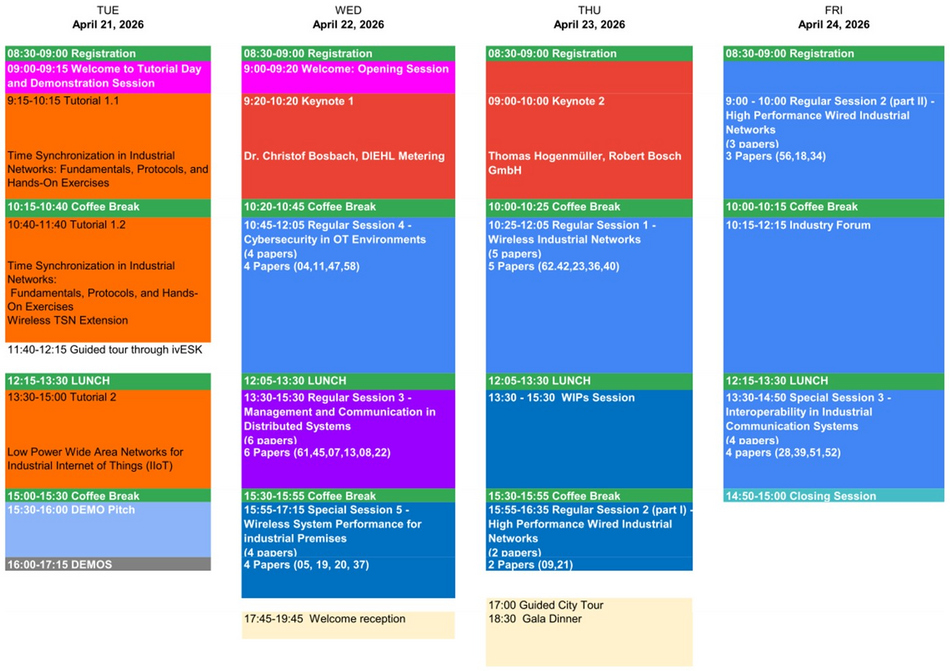
| 08:30-09:00 | Registration |
| 09:00-09:15 | Welcome to Tutorial Day and Demonstration Session |
| 09:15-10:15 |
Tutorial 1.1: Dr. Mahin Ahmed Silicon Austria Labs GmbH Time Synchronization in Industrial Networks: Fundamentals, Protocols, and Hands-On Exercises |
| 10:15-10:40 | Coffee Break |
| 10:40-11:40 |
Tutorial 1.2: Time Synchronization in Industrial Networks: Fundamentals, Protocols, and Hands-On Exercises Wireless TSN Extension |
| 11:40-12:15 | Guided tour through ivESK |
| 12:15-13:30 | LUNCH |
| 13:30-15:00 |
Tutorial 2: Wolfram Strauß, Fraunhofer IIS Nürnberg Low Power Wide Area Networks for Industrial Internet of Things (IIoT) |
| 15:00-15:30 | Coffee Break |
| 15:30-16:00 | DEMO Pitch |
|
Demonstration of an Automated Testbed for UWB Localization Experiments. Authors: Julian Karoliny, Alexander Kemptner, Hannah Brunner, Andreas Gaich, Michael Neubauer, Fjolla Ademaj-Berisha, Filippo Casamassima, Walther Pachler, Shrief Rizkalla, Harald Witschnig, Andreas Springer, Hans-Peter Bernhard. |
|
|
Demonstration of End-to-End Time Synchronization over 5G-TSN. Authors: Manuel Schappacher, Dominik Welte, Tobias Scheinert, Martin Kasparick, Stefan Senk, Axel Sikora, Frank H.P. Fitzek. |
|
|
Demonstration of Device Discovery on Device-Side 5G-TSN Bridge Translator. Authors: Christopher Lehmann, Dominik Welte, Manuel Schappacher, Axel Sikora, Thomas Höschel, Frank H. P . Fitzek. |
|
|
A Discrete-Event Simulator for TSCH Networks. Authors: Stefano Scanzio, Gianluca Cena. |
|
|
Remote PID Control over 5G-TSN: A Self-Balancing Robot as Demonstration of Traffic Convergence and Dejittering. Authors: José Fontalvo-Hernández, Ramanan Bhaskar, Ramanan Bhaskar, Andreas Zirkler. |
|
|
Wireless Enabled Situationally Aware Robot Collaboration in Industrial Environments. Authors: Alexander Raab, Wolfgang Pointner, Damir Hamidovic, Hans-Peter Bernhard. |
|
|
Demonstrating High-Precision Time Synchronization for Industrial Applications over 5G. Authors: Michael Gundall, Daniel Lindenschmitt, Julian Remmet, Hans D. Schotten. |
|
|
Demo Paper: Trusted Robotic Toolkit. Authors: Julian Weihe, Vlado Handziski, Patrick Erbts, Niels Karowski, Sebastian Kruse. |
|
|
A Multi-Technology Experimentation Platform for Heterogeneous Industrial IoT Communications: From LPWAN to Private 5G Towards 6G-IoT Testbeds. Authors: Fabian Sowieja, Robin Thomas, Jubin Sebastian-E. |
|
| 16:00-17:15 | DEMOS |
| 08:30 - 09:00 | Registration |
| 09:00-09:20 | Welcome: Opening Session |
| 09:20 - 10:20 | Keynote 1: Dr. Christof Bosbach, DIEHL Metering |
| 10:20 - 10:45 | Coffee Break |
| 10:45-12:05 | Regular Session 4: Cybersecurity in OT Environments (4 papers) |
|
10:45-11:05 An Empirical Analysis of Automated Classification of Industrial Cybersecurity Requirements in Factory Automation - Padma Iyenghar |
|
|
11:05- 11:25 Evaluating LLMs for Operational Technology (OT) Cybersecurity Risk Assessment Across Structured and Unstructured Inputs - Padma Iyenghar, Jonny Messerknecht, Christopher Zimmer, Claudio Gregorio, Elke Pulvermueller |
|
|
11:25-11:45 DTLS Handshake Optimization with SCHC in LPWAN: Testbed Implementation and Performance Analysis - David Stark, Anu Sathyajith Mathew,Axel Sikora |
|
|
11:45-12:05 Real-Time Intrusion Detection in IIoT/OT Networks via Traffic-Feature Forecasting: A Testbed Study - Mhamad Bakro, Andrea Marotta, Walter Tiberti, Ottorino Odoardi, Ivano Salvatore, Piergiuseppe Di Marco |
|
| 12:05-13:30 | Lunch |
| 13:30 - 15:00 | Regular Session 3 - Management and Communication in Distributed Systems (6 papers) |
|
13:30-13:50 ORCA: An Orchestrated CNC Architecture for Model-Driven TSN Management in Industrial Networks - Krithiga Ramesh, Arne Neumann, Juergen Jasperneite |
|
|
13:50-14:10 Simultaneous Multi-Function Aggregation in industrial networks oriented Multi-Group NOMA - li yinfei, Hussein Abrahim, weiyan hou, shijie shi |
|
|
14:10-14:30 AGFTNet: Learning Reliable Spatio-Temporal Risk Patterns from Sparse Data for Urban Traffic Accident Early Warning Systems - Wenjie Su, En Fan, Qi Li, Zhaoxi Fang, Yuxuan Chen, Yifan Huang |
|
|
14:30-14:50 Architecture Meets Automation: Mapping Building Information Modeling to Industrie 4.0 Digital Twins - Mohammadamin Sedigh, Frank Hilbert, Marko Ristin, Tobias Langer, Jochen Müller, Martin Wollschlaeger, Hans Wernher van de Venn |
|
|
14:50-15:10 Enhancing Energy Efficiency in 5G Radio Access Networks by Digital Twin and Machine Learning - Salvatore Cavalieri, Raffaele Di Natale, Mirco Arcangelo Antona, Salvatore Quattropani, Orazio Pistara |
|
|
15:10-15:30 Predictive Routing Using Kalman Filtering under GPS Uncertainty in UAV 3D FANETs - Phuoc Dang, Chan Thai Truyen Dai, Son Vo Nguyen, Khoi Tran Quang |
|
| 15:30-15:55 | Coffee Break |
| 15:55 -17:15 | Special Session 5 - Wireless System Performance for industrial Premises (4 papers) |
|
15:55-16:15 End-effector Pose Extrapolation using Wireless Channel State Information - Karl Montgomery, Nathan Wei, Jing Geng, Mohamed Kashef, Richard Candell |
|
|
16:15-16:35 Automated Testbed for Repeatable Evaluation of Ultra-Wideband Localization Performance - Alexander Kemptner, Julian Karoliny, Andreas Gaich, Michael Neubauer, Fjolla Ademaj, Shrief Rizkalla, Andreas Springer, Hans-Peter Bernhard, Hannah Brunner, Filippo Casamassima, Walther Pachler, Harald Witschnig |
|
|
16:35-16:55 Towards Secure and Safe Industrial Systems using BLE’s Broadcast Isochronous Streams - Sebastian Dorn, Fikret Basic, Rainer Hofmann, Michael Spörk, Carlo Alberto Boano |
|
|
16:55-17:15 Wi-Fi Channel Quality Prediction with Liquid Neural Networks - Stefano Scanzio, Parishad Pourrajab, Lukasz Wisniewski, Gianluca Cena |
|
| 17:15 | End of session |
| 17:15-19:45 | Welcome reception |
| 08:30 - 09:00 | Registration |
| 09:00 - 10:00 | Keynote 2: Thomas Hogenmüller, Robert Bosch GmbH |
| 10:00 - 10:25 | Coffee Break |
| 10:25- 12:05 | Regular Session 1 - Wireless Industrial Networks (5 papers) |
|
10:25-10:45 Performance Evaluation of Fischer-Huber Bitloading Algorithm for LiFi over PLC - Atiyeh Pouralizadeh, Luis Miguel Giraldo, Joaquin Perez Soler, Dennis Goodson, Volker Jungnickel |
|
|
10:45-11:05 Empirical Performance Assessment of DECT NR+ for Wireless Industrial Communications - Paula Martinez, JON MONTALBAN SANCHEZ, Iñaki Eizmendi, Eneko Iradier, Marta Fernandez, Inigo Bilbao |
|
|
11:05-11:25 MANTIS: Towards Multiparty Communication for Bluetooth LE Audio - Theo Gasteiger, Markus Schuß, Carlo Alberto Boano, Kay Römer |
|
|
11:25-11:45 Robust Device-Free CSI-based Wi-Fi Tracking Using a Cascaded Multi-Target Tracker - Leon Horn, Roya Khanzadeh, Thomas Wagner, Tim B. Johansson, Andreas Springer |
|
|
11:45-12:05 Binary Radio Environment Map Derived from Situational Awareness and RSRP Measurements - Tim Johansson, Fjolla Ademaj, Roya Khanzadeh, Andreas Springer, Damir Hamidovic, Bernhard Etzlinger, Leon Horn, Hans-Peter Bernhard |
|
| 12:05- 13:30 | Lunch |
| 13:30- 15:30 | WIP Session |
|
13:30-13:35 Evaluating Agreement Beyond Chance in LLM-Based Hazard Severity Classification for Railway Functional Safety. Authors: Padma Iyenghar, Claudio Gregorio |
|
|
13:35-13:40 Quantifying Wet-Antenna Detuning at 868 MHz for LoRa Nodes and a Path to Adaptive Matching. Authors: Mohammed Jajere Adamu, Niels Neumann. |
|
|
13:40-13:45 Feasibility study on IO-Link Wireless Low Power. Authors: Stefan Braun, Matthias Beyer, Ulrich Baur, Christoph Boeckenhoff, Albert Dorneich. |
|
|
13:45-13:50 Preliminary experimental evaluation of time synchronization parameters in openSAFETY over IEEE 802.11 wireless networks. Authors: Shoaib Zafar, Alessandro Biondi, Salvatore Sabina, Giorgio Buttazzo. |
|
|
13:50-13:55 CoAnalyst: An Agentic, LLM-based Cybersecurity Analyst for Industrial Control Systems. Authors: Eren Çil, Jaafer Rahmani, Axel Sikora. |
|
|
13:55-14:00 TSN Delay and Jitter Prediction Using Machine Learning Regressors. Authors: Adrian Albrecht, Vitaliy Yakovyna, Jonathan Samuel Ndop, Kedar Dnyaneshwar Naik, Axel Sikora. |
|
|
14:00-14:05 Characterizing Domain Shift in PROFINET Intrusion Detection: A Multi-Site Ground-Truth Evaluation. Authors: Jaafer Rahmani, Emiliano Sisinni, Paolo Ferrari, Kai Oliver Detken, Axel Sikora. |
|
|
14:05-14:10 HMO–Hierarchical Monitoring Framework for Heterogeneous Multi-Domain TSN Orchestration in Industry 4.0. Authors: Seyedali Hadian, Manuel Schappacher, Dominik Welte, Kedar Naik, Axel Sikora. |
|
|
14:10-14:15 Preparing the Stage for Ambient Internet of Things: A Study of Positioning Protocols in 5G Networks. Authors: Nico Kalis, Muhammad Shahrukh, Benjamin Rother, Sven Pawletta, Christian Haubelt, Frank Golatowski. |
|
|
14:15-14:20 DALE: DTLS Adaptive Layer Extension for Constrained IoT Networks. Authors: Anu Sathyajith Mathew, Manuel Schappacher, Axel Sikora. |
|
|
14:20-14:25 Unified Multi-RAT Control for Industrial NPNs: O-RAN-Based Management of openwifi APs. Authors: Pablo Avila Campos, Jetmir Haxhibeqiri, Vasilis Maglogiannis, Dries Naudts, Jeroen Hoebeke. |
|
|
14:25-14:30 Automated Park & Charge: Architecture and Evaluation of Coordinated EV Charging in Automated Parking Facilities. Authors: Bassem Hichri, Mohamed Amine Mejri, Fabian Durkop, Axel Sturm. |
|
|
14:30-14:35 Admission control and scheduling of periodic real-time flows in IEEE 802.11be networks. Authors: Mattia Pirri, Zenepe Satka, Luca Leonardi, Mohammad Ashjaei, Gaetano Patti, Lucia Lo Bello. |
|
|
14:35-14:40 Towards consistent Management of integrated 5G and TSN Networks. Authors: Arne Neumann, Krithiga Ramesh, Dominik Welte, Manuel Schappacher, Axel Sikora. |
|
|
14:40-14:45 Toward Server-Side Scheduling on LoRaWAN. Authors: Onoriode Akporherhe, Luis Almeida. |
|
|
14:45-14:50 Precise Indoor Positioning using Hybrid Fine Time Measurements over Radio and Light Waves. Authors: Dennis Goodson, Christoph Kottke, Volker Jungnickel. |
|
| 14:50-15:30 | Poster session of WiP papers |
| 15:30-15:55 | Coffee Break |
| 15:55-16:35 | Regular Session 2 (part I) - High Performance Wired Industrial Networks (2 papers) |
|
15:55-16:15 An Enhanced Incremental Scheduling Strategy with Rescue Mechanism for CQF-based Time-Sensitive Networking - Yuan-Yao Shih, Yi-Peng Lu |
|
|
16:15-16:35 Enhancing Industrial Ethernet Performance: A Comparative Study of PROFINET Software Development Kit with AF PACKET and XDP - LOKMAN ALTIN, HAYRI MUTLU, ULAS AKIN, ALI ARGUN BERBEROGLU, OMER KORCAK |
|
| 16:35 | End of session |
| 17:00 | Guided City Tour |
| 18:30 | Gala Dinner |
| 08:30 - 09:00 | Registration |
| 09:00 - 10:00 | Regular Session 2 (part II) - High Performance Wired Industrial Networks (3 papers) |
|
09:00- 09:20 Experimental Evaluation of TSN–5G Interworking for Cyclic Industrial Traffic - Kedar Naik, Seyedali Hadian, Manuel Schappacher, Dominik Welte, Andreas Laufer, Axel Sikora |
|
|
09:20-09:40 In-Band Full-Duplex Communication for Scalable and Deterministic Industrial Networks - Eneko Iradier, Erick Jimenez, Iñigo Bilbao, JON MONTALBAN SANCHEZ, Pablo Angueira |
|
|
09:40-10:00 Towards a Large Scale Data-Driven Smart Manufacturing Communication System - Jakob Rothe, Raven Reisch, Thomas Runkler |
|
| 10:00 - 10:15 | Coffee Break |
| 10:15 - 12:15 | Industry Forum |
| 12:15 - 13:30 | Lunch |
| 13:30 - 14:50 | Special Session 3: Interoperability in Industrial Communication Systems (4 papers) |
|
13:30-13:50 Failure Detection for Industrial Wireless Links via Interoperable Data Fusion - Maria Gusmão, Eduardo Luz, Luis Uzeda Garcia |
|
|
13:50-14:10 Software Development of I4.0 Digital Twins for Programmable Logic Controllers - Nico Braunisch, Santiago Soler Perez Olaya, Uwe Schmidt, Martin Wollschlaeger |
|
|
14:10-14:30 Teleoperating Mobile Robots via VDA 5050 – A First Middleware Evaluation within Open Industrial Networks - Niklas A. Wagner, Lars Tönning, Dennis Lünsch, Jana Jost, Christian Wietfeld, Peter Detzner |
|
| 14:30-14:50 |
14:30-14:50 Interoperability as a Fundamental Enabler of Industry 4.0: the Definition of a Life-Cycle Property - Inés Álvarez, Guillermo Rodriguez-Navas, Pablo Grande |
| 14:50 - 15:00 | Closing Session |
| 15:00 | End of the conference |
Keynotes
Keynote 1: Wireless Resilient Data Communication Networks for Intelligent Applications in Smart Cities and Smart Industries
Keynote Speaker: Dr. Christof Bosbach, President of the Division Board DIEHL Metering, Member of the Executive Board at DIEHL Group

The digital revolution is fundamentally transforming cities and industries: intelligent sensors, big data and AI are optimizing traffic flows, energy consumption and production processes. Factories are becoming more autonomous, cities smarter. Decisions are increasingly based on (real-time) data, which significantly improves efficiency, sustainability and quality of life. The future will be data-driven and networked.
As cities and industry increasingly rely on digital technologies, data and AI, data communication networks must be particularly efficient and resilient. They form the backbone of these networked systems and ensure that critical infrastructures such as energy supply, traffic management systems and production facilities remain functional even under difficult conditions. A failure can have far-reaching consequences - from economic damage to threats to public safety. Resilient networks are secure against cyber-attacks, natural disasters and technical defects by enabling redundancy, self-healing and rapid recovery. Only robust communication structures can make the digital transformation secure, reliable and sustainable - and ensure long-term trust in smart technologies.
In this keynote, Dr. Bosbach will explain with the use-case of smart metering, which requirements such resilient communication networks have to meet. He will also give an insight on the impact of the digital revolution on companies, and how they try to cope with these challenges. Solutions include technological advances, profound and steady modernization of organizations, and collaboration with market partners.
Keynote 2: Ethernet’s Role in Centralizing Automotive E/E-Architectures – Insights for Industrial Automation
Keynote Speaker: Thomas Hogenmüller, Director R&D In-Vehicle Networks at Robert Bosch GmbH

Director R&D In-Vehicle Networks at Robert Bosch GmbH
As OEMs shift from domain based toward centralized and zonal E/E architectures, Ethernet has become the core enabler of high-bandwidth, low-latency communication in automotive systems. This keynote delves into how technologies like Time-Sensitive Networking (TSN), IEEE1722, Software Defined Networking, but also the scalable Automotive Physical Layer from 10 Mb/s up to 50 Gb/s are used to meet stringent real-time and safety requirements across ADAS, infotainment, and powertrain domains. As well the focus on this talk is how to reduce the total cost of ownership towards the lifecycle of a vehicle platform.
We explore architectural transitions from domain controllers to central compute nodes, the role of Ethernet switches in zonal gateways and the transition between an embedded signal-based domain and the compute domain with service orientation. Parallels are drawn to industrial automation, where similar demands for deterministic communication, modular scalability, and reduced system complexity are driving adoption of Ethernet-based fieldbus replacements.
The realization of these new architectures and their associated network technologies demands a new set of processes, methods, and tools.
Tutorials
Time Synchronization in Industrial Networks: Fundamentals, Protocols, and Hands-On Exercises
Dr. Mahin Ahmed (Silicon Austria Labs GmbH) & Lucas Haug (Institute for Parallel and Distributed Systems, University of Stuttgart)
Abstract:
Accurate time synchronization is essential for modern industrial communication systems, enabling deterministic communication, coordinated control, distributed sensing, and safety-
critical applications.
The first unit of the tutorial introduces the fundamentals of time synchronization for industrial networks, covering clock models, performance metrics, and key protocols such as IEEE
1588 Precision Time Protocol (PTP), industrial Ethernet profiles, and emerging wireless solutions. It focuses on Time-Sensitive Networking (TSN) and 5G, explaining how synchronization is implemented and how industrial requirements are met, including in integrated 5G-TSN networks.
The second unit of the tutorial includes a hands-on session complements the theory, allowing participants to simulate, configure, and evaluate time synchronization using practical tools for industrial network scenarios.
Description:
Accurate and reliable time synchronization is a fundamental enabler for modern industrial communication systems, supporting deterministic communication, coordinated control, distributed sensing, and safety-critical applications. As industrial networks evolve toward converged wired–wireless architectures, achieving precise end-to-end time alignment across heterogeneous technologies has become both more critical and more challenging.
This tutorial provides a comprehensive and structured introduction to time synchronization in industrial networks. It starts with fundamental concepts, including clock models, synchronization accuracy and precision, error sources, and commonly used performance metrics. Building on these foundations, the tutorial surveys the main synchronization protocols used in industry. A particular emphasis is placed on Time-Sensitive Networking (TSN) and 5G. The tutorial explains how time synchronization is realized within each technology, how stringent industrial requirements are addressed, and how synchronization performance impacts real-time communication. Furthermore, the tutorial explores integrated 5G-TSN networks, discussing architectural aspects, synchronization distribution across wired and wireless domains, and the challenges of achieving end-to-end time alignment in converged industrial systems. Additionally, the tutorial will also focus on introducing fault-tolerance in time synchronization protocols.
In addition to the theoretical foundations, the tutorial includes a hands-on session in which participants will actively use practical tools to simulate, configure, and evaluate time synchronization in representative industrial network scenarios using reproducible, tool-based exercises. This session directly connects theoretical concepts from the earlier units with measured synchronization performance, enabling practical understanding and application. This combination of theory, discussion, and practical exercises ensures that participants gain both conceptual understanding and actionable skills relevant for research, system design, and deployment.
Outline:
- Introduction and Motivation
- Role of time synchronization in industrial automation
- Use cases: deterministic networking, coordinated control, distributed sensing
- Overview of challenges in modern industrial systems
- Fundamentals of Time Synchronization
- Clock models and clock behavior
- Accuracy vs. precision
- Synchronization error sources
- Performance metrics and evaluation criteria
- Industrial Time Synchronization Protocols
- Synchronization mechanisms in TSN
- 5G time synchronization concepts and architecture
- Requirements and performance considerations for industrial use cases
- Integrated 5G-TSN Networks
- Architectural overview
- Synchronization distribution across wired and wireless domains
- Key challenges for end-to-end synchronization
- Fault-Tolerance in Time synchronization
- Types of faults
- Fault-tolerance mechanisms
- Standardized approaches
- Hands-On Session and Discussion
- Simulation and configuration of synchronization scenarios
- Evaluation of synchronization performance
- Interactive discussion and Q&A
Low Power Wide Area Networks for Industrial Internet of Things (IIoT)
Wolfram Strauß (Fraunhofer IIS Nürnberg)
Abstract:
LPWAN technologies are indispensable for IIoT, offering the necessary connectivity, scalability, and efficiency to support a wide array of industrial applications. To make a well founded decision, it is important to have a basic understanding of key strengths and weaknesses of the technology in general and of the different systems within the LPWAN family.
In the first part of the tutorial, an application context with example uses cases, a technology overview, and the main representatives are presented. The second portion elaborates on technological details of selected systems. In the last section, two systems (LoRaWAN, mioty) are compared, based on key features.
Description:
Data driven processes are transforming all sectors of our life, such as manufacturing. Better efficiency, more transparency, quicker response time and less use of resources are demanded. Especially environmental concerns are becoming a focal point in the industrial context, which is emphasized by e.g. the EU directive „Corporate Sustainability Reporting Directive“ (CSRD). To collect necessary data in complex and dynamic industrial processes, wireless technologies are key. Low Power Wide Area Networks (LPWAN) can provide an important contribution to solve these tasks.
To make an informed decision for the use case at hand, a technological background is needed, which shows key features, but also weaknesses of the LPWAN technology as a whole. Furthermore a distinction between
Outline
- Introduction
- Personal background / IIS
- Context / motivation
- Use cases
- LPWAN overview
- Representatives: LoraWAN, mioty, NB-IoT / LTE-M, Sigfox, ...
- Selection
- Break
- LPWANs in detail
- LoRaWAN
- mioty
- NB-IoT
- Break
- LPWAN comparison
- Cell-based - non-cellular based
- Key performance indicators
- LoRaWAN - mioty
- Conclusion
- Q&A
Sponsors