
IBMS – Institute for Advanced Biomechanics and Motion Studies

Welcome to the Institute for Advanced Biomechanics and Motion Studies
We study human biomechanics as an interdisciplinary science that applies mechanical principles to biological systems. Our research focuses on fall prevention and sports biomechanics, with an emphasis on understanding how to improve human-technology interaction (e.g., with athletic shoes, orthoses, prostheses, and flooring). We develop modern methods for motion analysis both inside and outside of laboratory settings and analyze extensive biomechanical datasets.

Research and development projects
Complex biomechanical movement analyses play a decisive role in today's research landscape. These analyses not only provide insights into human movement in everyday life, but are also of great importance in the context of demographic change. In view of an aging population, fall prevention and the optimization of joint loading are crucial challenges. The IBMS is working intensively to develop innovative approaches to minimize the risk of falls and at the same time improve the quality of life of older people.
Another focus is on the interaction between people and technology. Research is being conducted into how various technological solutions such as footwear, insoles, orthoses, walking aids and robotic support systems can influence human movement. This enables the development of customized solutions that not only improve comfort, but also promote mobility and independence.
In a sports context, complex movement analyses also play a decisive role in improving athletic performance and preventing injuries. Athletes and coaches use these analyses to optimize movement patterns in order to avoid injuries caused by both trauma and overuse. In addition, biomechanical analyses are also crucial for the rehabilitation of injuries in sport. Through special tests such as the "Return to Sport" test, athletes can safely return to their sporting activities after being injured.
Another significant area of research is focused on the development of methods outside of laboratory situations. Here, wearable sensors and innovative data acquisition technologies are used to carry out movement analyses in real environments. In addition, functional statistics play a central role in gaining relevant insights from the collected data. The analysis of large biomechanical data sets enables researchers to recognize patterns, understand correlations and thus derive well-founded recommendations for prevention, rehabilitation and performance enhancement.
A Glimpse into Our Research
Developing new methods. Optimizing processes. Driving innovation. At IBMS, we seek answers to research questions. Our project directory lists all the projects we are carrying out in collaboration with partners from academia and industry. There, you can search for all ongoing and completed projects since 2014. You can find the latest milestones and breakthroughs in our daily work under Insights.
Biomechanics Labs
The Biomechanics Laboratory at Campus West is well equipped to conduct extensive and detailed studies of human movement, sports equipment and interdisciplinary research areas. Here is an overview of the biomechanical laboratories at IBMS:

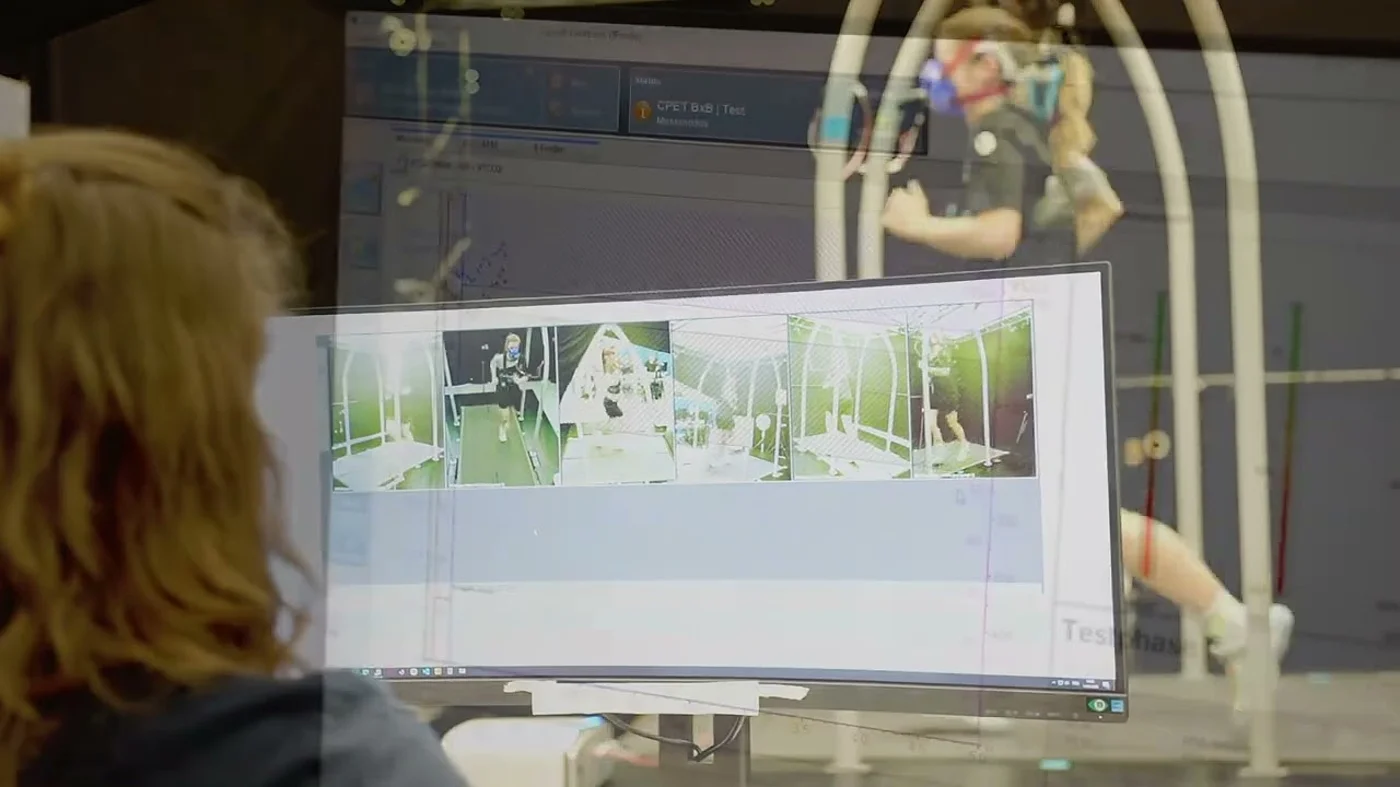
Measuring site complex 3D motion analysis Treadmill
Measurement systems/software
Force Plate instrumented treadmill (Bertec) |
| Measures forces that arise between the subject and the environment. Together with the movement data, forces and moments acting on the body can be calculated. |
Qualisys Motion Capture System |
| Marker-based camera system for precise recording of 3D movement data |
Theia 3D |
| Markerless 3D motion capture system based on video data and artificial intelligence |
OpenCap |
| A mobile markerless tracking system for motion analysis with iPad cameras |
Spiroergometry system (Vyaire & COSMED) |
| Captures respiratory gases to determine the economy of movement |
Lactate measurement |
| Used to determine the blood lactate concentration to assess the metabolic state. |


Measuring site complex 3D motion analysis Overground
Measurement systems/software
Contemplas starting block with integrated force measurement |
| Captures 3D forces in sprinting or take-off movements |
AMTI force plates |
| Measure ground reaction forces during movements on solid ground |
Qualisys Motion Capture System |
| Marker-based camera system for precise recording of 3D movement data |
Theia 3D |
| Markerless 3D motion capture system based on video data and artificial intelligence |
Witty Light barrier system |
| Measures running speeds and reaction times |
Special floor coverings (synthetic track from CONICA/ artificial turf/ asphalt) |
| Enable realistic movement analyses on different surfaces |
Noraxon IMU sensors |
| Sensors for wireless recording of movement |


Measuring site complex 3D motion analysis High-speed treadmill
Measurement systems/software
hp cosmos high-speed treadmill |
| Enables controlled running at very high speeds (up to 80 km/h) |
Baumer highspeed cameras |
| High-speed cameras for detailed motion analysis |
Templo Software |
| Software for synchronized video and motion analysis |
Theia 3D |
| Markerless 3D motion capture system based on video data and artificial intelligence |


Interactive laboratory for 3D locomotion analysis in real time
Measurement systems/software
Gait Real-time Analysis Interactive Lab (GRAIL, Motek) |
| Integrated system for real-time analysis of gait movements in a VR environment. |
Vicon Motion Capture System |
| Marker-based camera system for precise recording of 3D movement data |
3D Bodyscanner (Vitronic) |
| High-precision 3D body scanner that enables complete and automated morphological analysis |
3D Infoot2 Foot scanner (I-Ware Lab) |
| Captures the 3D foot shape |
Cometa EMG-System |
| Wireless EMG system for recording muscle activity. |
VR headset system |
| Virtual reality for immersive motion analysis in real time. |
Tobii Eye Tracker |
| Eye-tracking system for analyzing visual attention during movement. |


Isokinetic strength assessment
Measurement systems/software
ISOMED isokinetic system with modules for upper and lower extremities, as well as the leg press |
| Diagnostic and training system for measuring isokinetic muscle strength. |
Noraxon EMG system |
| Records the electrical activity of the muscles during tests and exercises. |


Bicycle spiro-ergometry
Measurement systems/software
SRM Bicycle ergometer |
| High-precision ergometer for performance diagnostics in cycling. |
Spiroergometry system (Vyaire & COSMED) |
| Captures respiratory gases to determine the economy of movement |


Measuring site for material testing
Measurement systems/software
Pneumatic force simulator |
| Generates reproducible impulse loads for material testing. |
AMTI force plate |
| Measures the forces acting on materials or structures. |
ZwickRoell LTM10 Material testing machine |
| Tests mechanical properties of materials under various loads. |


Offenburg Center for Fall Prevention Research (ZSO)

Understanding, preventing, and minimizing the consequences of falls: The Offenburg Center for Fall Prevention Research (ZSO) at the Institute for Advanced Biomechanics and Motion Studies (IBMS) of Hochschule Offenburg brings together interdisciplinary research on safe mobility. The goal is to translate scientific findings into effective, practical solutions for greater independence and quality of life.
Falls can significantly impair mobility, autonomy, and social participation. Against the backdrop of an aging society and declining physical activity, the ZSO investigates how fall risks arise, how they can be detected early, and how they can be reduced through training, technical assistance, and environmental design. To this end, the center combines expertise in biomechanics, human-computer interaction, sensor technology, robotics, and data-driven methodologies.
Our four areas of research:
Basic Research
We investigate mechanisms of dynamic stability during walking and other everyday movements. Our research focuses on individual factors such as muscle strength, sensory abilities, and reaction time, as well as environmental conditions, such as ground surface, stairs, inclines, and declines.
Intervention Research
Based on experimental findings, we develop and evaluate training and technology-based interventions. These include strength, balance, and cognitive-motor training, as well as optimized footwear, orthoses, assistive devices, and exoskeletons. We evaluate their effectiveness, safety, and suitability for everyday use.
Human-Technology-Interaction
We are researching how technical systems can reduce the risk of falls and their consequences. Wearable sensors, smartphone data, and artificial intelligence methods are intended, among other things, to help detect changes in movement stability at an early stage and to develop personalized preventive measures.
Transfer and Real-Life-Implementation
Research makes an impact when it is integrated into everyday life. That is why we examine the acceptance, usability, and long-term adoption of the solutions we develop, and work with partners in healthcare, nursing, technology, and industry to translate them into products and services.
Participation in studies

Whether professional athlete, sports enthusiast or couch potato; there are numerous opportunities to participate in biomechanical studies and gain scientific insights. If there is any interest, registration in the IBMS subject database is possible using the following QR code.
The data provided is stored and as soon as the required inclusion criteria for a study are met, a notification is sent to potential test subjects. Participation in studies is voluntary and can be terminated at any time without repercussions.
If a participant wishes to withdraw from the database, this can be done by sending an e-mail, whereupon the corresponding data will be deleted. The corresponding e-mail address is: research.amlo@hs-offenburg.de
Additional information
Team


Research Assistants and Student Assistants
Abilash
Aniseh Boorboor
Khouloud Chtioui
Stina Einberger
Vivien Geese
Markus Jäger
Swars Kern
Natalie Röhrle
Contact and how to get there

Postal adress
Hochschule für Technik, Wirtschaft und Medien Offenburg
Institute for Advanced Biomechanics and Motion Studies
Badstr. 24
77652 Offenburg
Delivery address IBMS
HS Offenburg
Campus West
Gebäudehalle 101
Max-Planck Straße 1
77652 Offenburg
Publications
Book chapter
Beckerle, P., Willwacher, S., Liarokapis, M., Bowers, M. P., & Popovic, M. B. (2024). Prosthetic limbs. In Biomechatronics (pp. 276-316). Elsevier.
Korn, O., & Willwacher, S. (2022). Smart systems in rehabilitation and prevention. How artificial intelligence and gamification individualize exercise training. In Artificial intelligence in healthcare (pp. 867-879). Springer Gabler, Wiesbaden.
Journal article (peer reviewed)
Braun, L., Umberger, B. R., von Diecken, C., Hipper, M., Anedda, B., & Willwacher, S. (2026). Balance control after slip-like perturbations in human running when systematically altering forward trunk leaning. Journal of Experimental Biology, 229(15), jeb252592.
Fohrmann, D., Schaffarczyk, M., Menge, C., Willwacher, S., Sanchez-Alvarado, A., Gronwald, T., & Hollander, K. (2026). Biomechanical factors associated with intraindividual differences in running economy across advanced footwear technology models in long-distance runners. Sports Medicine Open, 12(1), 34.
Gronwald, T., Finnern, L. S., Wilke, J., Willwacher, S., Pasanen, K., Hollander, K., et al. (2026). Infographic. Video analysis of muscle strains in sport: qualitative and quantitative situational characteristics across muscle groups. British Journal of Sports Medicine.
Mai, P., Willwacher, S., Rahlf, L., Hoenig, T., Braun, L., von Diecken, C., Bill, K., et al. (2026). Situations leading to anterior cruciate ligament injury in sports: A systematic review with meta-analysis. Sports Medicine, 1–22.
Braun, L., Umberger, B. R., Joshi, V., Denis, Y., Anedda, B., & Willwacher, S. (2026). Humans choose trunk lean angles consistent with minimal metabolic costs—an integrative experimental and musculoskeletal simulation approach. Proceedings of the Royal Society B: Biological Sciences, 293(2063), 20252717.
Finnern, L. S., Wilke, J., Willwacher, S., Pasanen, K., Hollander, K., Dalos, D., et al. (2026). Qualitative and quantitative situational characteristics of muscle strains in sports: A systematic review and meta-analysis. British Journal of Sports Medicine.
Mussler, J., Lienhard, J., Shetty, S., Schmal, H., Rolauffs, B., & Seidenstuecker, M. (2026). Engineering intervertebral disc replacements using 3D-printed open Gyroid architectures. Biomedical Materials, 21(1), 015001.
Braun, L., Mai, P., Hipper, M., Denis, Y., Helwig, J., Anedda, B., Utku, B., et al. (2025). Managing lower extremity loading in distance running by altering sagittal plane trunk leaning. Journal of Sport and Health Science, 14, 100985.
von Diecken, C., Riedl, M., Willwacher, S., & Ueberschär, O. (2025). Runners with lower dynamic stability exhibit better running economy. Scientific Reports, 15(1), 38117.
Helwig, J., Vanrenterghem, J., Anedda, B., Koska, D., Hipper, M., Denis, Y., et al. (2025). Comparison of lower body joint kinematics during change of direction tasks estimated using a markerless and a marker-based method. Scientific Reports, 15(1), 34119.
Denis, Y., Braun, L., Hipper, M., Anedda, B., von Diecken, C., Helwig, J., et al. (2025). Determinants of footwear perception in running shoes with different compression stiffnesses. Footwear Science, 17(3), 167–178.
Willwacher, S., Denis, Y., Mai, P., von Diecken, C., & Braun, L. (2025). Quo vadis advanced footwear technology research? Journal of Sport and Health Science, 101071.
Spiess, T., Willwacher, S., Wolf, S., & Heitzmann, D. (2025). Marker-less motion capture – Differences to conventional 3D gait analysis in a clinical setting. Gait & Posture, 117, S31–S32.
Bill, K., Bartsch, J., Willwacher, S., Eriksrud, O., Mausehund, L., Kersting, U., ... & Mai, P. (2025). Same Same but Different: Why Both Sport-Specific Cutting Tasks and Generic Change-Of-Direction Tasks Might Need to Be Considered to Prevent ACL Injury. JOSPT Open, 3(2), 1-9.
Braun, L., Mai, P., Hipper, M., Denis, Y., Helwig, J., Anedda, B., ... & Willwacher, S. (2024). Managing lower extremity loading in distance running by altering sagittal plane trunk leaning. Journal of Sport and Health Science, 100985.
Rice, H., Mai, P., Sanno, M., & Willwacher, S. (2024). Tibial loading and damage accumulation in recreational and competitive male runners during a demanding 10 km run. European Journal of Sport Science, 24(1), 79-87.
Sumner, J., Wagner, K., Day, E. M., Thompson, J., Willwacher, S., & Trudeau, M. B. (2024). Advancing our ability to quantify an individual’s habitual motion path and deviation when running. Footwear Science, 16(2), 123-133.
Schwalm, L. C., Fohrmann, D., Schaffarczyk, M., Gronwald, T., Willwacher, S., & Hollander, K. (2024). Habituation does not change running economy in advanced footwear technology. International Journal of Sports Physiology and Performance, 19(11), 1285-1290.
Engel, F. A., Zehnter, F., Yona, T., Mai, P., Willwacher, S., Düking, P., & Sperlich, B. (2024). Acute physiological, biomechanical, and perceptual responses of runners wearing downward-curved carbon fiber insoles. Frontiers in Sports and Active Living, 6, 1340154.
Bleuel, J., Komnik, I., Mittendorfer, I., Michel, B., & Willwacher, S. (2024). Abnormal gait pattern in downhill hiking is related to muscular deficits of the knee flexors and extensors in active patients with total knee arthroplasty. Clinical Biomechanics, 111, 106150.
Krombholz, D., Willwacher, S., Consmüller, T., Linden, A., Utku, B., & Zendler, J. (2024). Comparison of an adaptive ankle brace to conventional taping for rehabilitation of acute ankle injury in young subelite soccer players: a pilot study. Journal of Sport Rehabilitation, 1(aop), 1-8.
Utku, B., Bähr, G., Knoke, H., Mai, P., Paganini, F., Hipper, M., ... & Willwacher, S. (2024). The effect of fresh and used ankle taping on lower limb biomechanics in sports specific movements. Journal of Science and Medicine in Sport, 27(11), 772-778.
Willwacher, S., Mai, P., Helwig, J., Hipper, M., Utku, B., & Robbin, J. (2024). Does advanced footwear technology improve track and road racing performance? an explorative analysis based on the 100 best yearly performances in the world between 2010 and 2022. Sports Medicine-Open, 10(1), 14.
Mai, P., Robertz, L., Robbin, J., Thelen, M., Kurz, M., Trudeau, M. B., ... & Willwacher, S. (2024). An analytical framework to understand individual running-related injury risk response patterns to footwear. Proceedings of the Institution of Mechanical Engineers, Part P: Journal of Sports Engineering and Technology, 238(3), 251-263.
Mai, C., Mai, P., Hinz, M., Saenger, R., Seil, R., Tischer, T., & Roessler, P. P. (2024). Females show worse functional outcome and quality of life compared to males 2 years after meniscus surgery: Data analysis from the German Arthroscopy Registry. Knee Surgery, Sports Traumatology, Arthroscopy.
Bill, K., Mai, P., Mausehund, L., Solbakken, S., Krosshaug, T., & Kersting, U. G. (2024). Individualized Technique Feedback for Instant Technique Improvements and Knee Abduction Moment Reductions–A New Approach for ‘Sidestepping’ACL Injuries?. International journal of sports physical therapy, 19(5), 535.
Bagehorn, T., Mai, P., Bill, K., Herbaut, A., de Zee, M., & Kersting, U. G. (2024). Effect of increased shoe longitudinal bending stiffness on ankle and foot biomechanics in jump-cut movements of low and high degrees. Footwear Science, 16(2), 135-146.
Schäfer, R., Trompeter, K., Fett, D., Heinrich, K., Funken, J., Willwacher, S., ... & Platen, P. (2023). The mechanical loading of the spine in physical activities. European Spine Journal, 1-11.
Rice, H., Kurz, M., Mai, P., Robertz, L., Bill, K., Derrick, T. R., & Willwacher, S. (2023). Speed and surface steepness affect internal tibial loading during running. Journal of sport and health science.
Rist, V., Block, J., Wolf, S. I., Alimusaj, M., Willwacher, S., & Heitzmann, D. (2023). Structured assessment of mobility and balance in people with a lower limb amputation utilising a combined protocol of functional tests. In Gait & Posture (Vol. 100, No. Supplement 1, pp. 107-108).
Willwacher, S., Bruder, A., Robbin, J., Kruppa, J., & Mai, P. (2023). A Multidimensional Assessment of a Novel Adaptive Versus Traditional Passive Ankle Sprain Protection Systems. The American Journal of Sports Medicine, 51(3), 715-722.
Schmidt, M., Nolte, K., Terschluse, B., Willwacher, S., & Jaitner, T. (2023). Positive influence of neuromuscular training on knee injury risk factors during cutting and landing tasks in elite youth female handball players. German Journal of Exercise and Sport Research, 53(1), 19-29.
Kolodziej, M., Groll, A., Nolte, K., Willwacher, S., Alt, T., Schmidt, M., & Jaitner, T. (2023). Predictive modeling of lower extremity injury risk in male elite youth soccer players using LASSO regression. Scandinavian Journal of Medicine & Science in Sports.
Helwig, J., Diels, J., Röll, M., Mahler, H., Gollhofer, A., Roecker, K., & Willwacher, S. (2023). Relationships between External, Wearable Sensor-Based, and Internal Parameters: A Systematic Review. Sensors, 23(2), 827.
Fohrmann, D., Hamacher, D., Sanchez-Alvarado, A., Potthast, W., Mai, P., Willwacher, S., & Hollander, K. (2023). Reliability of Running Stability during Treadmill and Overground Running. Sensors, 23(1), 347.
Willwacher, S., Robbin, J., Eßer, T., & Mai, P. (2023). Bewegungsanalysesysteme in der Forschung und für niedergelassene Orthopädinnen und Orthopäden. Die Orthopädie, 52(8), 610-617.
Willwacher, S., & Weir, G. (2023). The future of footwear biomechanics research. Footwear Science, 15(2), 145-154.
Hoenig, T., Rahlf, A. L., Wilke, J., Willwacher, S., Mai, P., Hollander, K., ... & Gronwald, T. (2023). Bewertung der methodischen Qualität wissenschaftlicher Studien in der Sporttraumatologie: Die QA-SIVAS Skala und ihre Reliabilität, Konstruktvalidität und Praktikabilität. In Sports Orthopaedics and Traumatology (Vol. 39, No. 2, pp. 190-191).
Wilke, J., Rahlf, A. L., Füzéki, E., Groneberg, D. A., Hespanhol, L., Mai, P., de Oliveira, G. M., Robbin, J., Tan, B., Willwacher, S., Hollander, K., & Pillay, J. D. (2022). Physical Activity During Lockdowns Associated with the COVID-19 Pandemic: A Systematic Review and Multilevel Meta-analysis of 173 Studies with 320,636 Participants. Sports Medicine - Open, 8(1), 125.
Willwacher, S., Kurz, M., Robbin, J., Thelen, M., Hamill, J., Kelly, L., & Mai, P. (2022). Running-Related Biomechanical Risk Factors for Overuse Injuries in Distance Runners: A Systematic Review Considering Injury Specificity and the Potentials for Future Research. Sports Medicine, 1-15.
Bill, K., Mai, P., Willwacher, S., Krosshaug, T., & Kersting, U. G. (2022). Athletes with high knee abduction moments show increased vertical center of mass excursions and knee valgus angles across sport-specific fake-and-cut tasks of different complexities. Frontiers in sports and active living, 4, 1-13.
Willwacher, S., Fischer, K. M., Rohr, E., Trudeau, M. B., Hamill, J., & Brüggemann, G. P. (2022). Surface stiffness and footwear affect the loading stimulus for lower extremity muscles when running. Journal of strength and conditioning research, 36(1), 82-89.
Alt, T., Oeppert, T. J., Zedler, M., Goldmann, J. P., Braunstein, B., & Willwacher, S. (2022). A novel guideline for the analysis of linear acceleration mechanics-outlining a conceptual framework of 'shin roll'motion. Sports Biomechanics, 1-18.
Salzano, M.Q., Weir, G., Thompson, J., Trudeau, M.B., Ertel, C., Dear, K., Willwacher, S. and Hamill, J. (2022). Can footwear satisfaction be predicted from mechanical properties? Footwear Science, 1-11.
Kolodziej, M., Willwacher, S., Nolte, K., Schmidt, M., & Jaitner, T. (2022). Biomechanical Risk Factors of Injury-Related Single-Leg Movements in Male Elite Youth Soccer Players. Biomechanics, 2(2), 281-300.
Mai, P., Robertz, L., Robbin, J., Thelen, M., Kurz, M., Trudeau, M. B., ... & Willwacher, S. (2022). An analytical framework to understand individual running-related injury risk response patterns to footwear. Proceedings of the Institution of Mechanical Engineers, Part P: Journal of Sports Engineering and Technology, 17543371221100044.
Zaeske, C., Brueggemann, G. P., Willwacher, S., Maehlich, D., Maintz, D., & Bratke, G. (2022). The behavior of T2* and T2 relaxation time in extrinsic foot muscles under continuous exercise: A prospective analysis during extended running. Plos one, 17(2), e0264066.
Ruth, J., Willwacher, S., & Korn, O. (2022). Acceptance of Digital Sports: A Study Showing the Rising Acceptance of Digital Health Activities Due to the SARS-CoV-19 Pandemic. International Journal of Environmental Research and Public Health, 19(1), 596.
Hahn, S., Kröger, I., Willwacher, S., & Augat, P. (2021). Reliability and validity varies among smartphone apps for range of motion measurements of the lower extremity: a systematic review. Biomedical Engineering/Biomedical Engineering.
Werkhausen, A., Willwacher, S., & Albracht, K. (2021). Medial gastrocnemius muscle fascicles shorten throughout stance during sprint acceleration. Scandinavian journal of medicine & science in sports, 31(7), 1471-1480.
Mai, P., Robertz, L., Thelen, M., Weir, G., Trudeau, M. B., Hamill, J., & Willwacher, S. (2021). A method to quantify stiffness across the entire surface of a shoe's midsole. Footwear Science, 13(2), 105-116.
Bratke, G., Willwacher, S., Siedek, F., Maintz, D., Mählich, D., Weiss, K., ... & Brüggemann, G. P. (2021). Insights into extrinsic foot muscle activation during a 75 min run using T2 mapping. Scientific Reports, 11(1), 1-10.
Wilke, J., Hollander, K., Mohr, L., Edouard, P., Fossati, C., González-Gross, M., ... & Tenforde, A. S. (2021). Drastic reductions in mental well-being observed globally during the COVID-19 pandemic: results from the ASAP survey. Frontiers in medicine, 8, 578959.
Okudaira, M., Willwacher, S., Kuki, S., Yoshida, T., Maemura, H., & Tanigawa, S. (2021). Effect of incline on lower extremity muscle activity during sprinting. The Journal of Physical Fitness and Sports Medicine, 10(2), 67-74.
Mai, P., Robertz, L., Thelen, M., Weir, G., Trudeau, M. B., Hamill, J., & Willwacher, S. (2021). A method to quantify stiffness across the entire surface of a shoe's midsole. Footwear Science, 1-12.
Conference abstract (peer reviewed)
Denis, Y., Braun, L., Anedda, B., Rehorst, S., Diecken, C., Sikeler, L., Helwig, J., et al. (2025). Exploring the multifactorial determinants of running shoe perception. Footwear Science, 17(sup1), S173–S174.*
Braun, L., Sikeler, L., Göbel, P., Denis, Y., Anedda, B., Helwig, J., von Diecken, C., et al. (2025). Novel adaptive shoe closure systems do not sacrifice whole-body and joint-level performance during linear acceleration and 180° cutting manoeuvres. Footwear Science, 17(sup1), S148–S149.*
Kerr, J., Nahan, K., Willwacher, S., & McDonald, K. (2025). Does advanced footwear technology change the way we walk? Footwear Science, 17(sup1), S93–S94.*
Sikeler, L., Braun, L., Göbel, P., Denis, Y., Anedda, B., Helwig, J., von Diecken, C., et al. (2025). Adaptive shoe closure systems perform better than or equally well as traditional lacing in keeping the heel in position relative to the midsole during sport-specific tasks. Footwear Science, 17(sup1), S50–S51.*
Rehorst, S., Brüggemann, G. P., & Willwacher, S. (2025). The impact of self-reported footwear, training, and individual factors on self-reported running-related injury risk: Insights from the Run Better research study. Footwear Science, 17(sup1), S108–S109.*
Nahan, K., Héroux, M., Willwacher, S., Kerr, J., & McDonald, K. A. (2025). Effect of advanced footwear technology on proximal joint work distribution while running with plantar flexor fatigue. Footwear Science, 17(sup1), S87–S88.*
Helwig, J., Anedda, B., Rehorst, S., Braun, L., Denis, Y., von Diecken, C., et al. (2025). Footwear-aligned utilized traction: Implications for footwear design. Footwear Science, 17(sup1), S65–S66.*
Schwalm, L. C., Fohrmann, D., Schaffarczyk, M., Gronwald, T., Willwacher, S., & Hollander, K. (2024). Auswirkungen der Habituation auf die Laufökonomie in Advanced Footwear Technology Schuhen.
Mai, P., Bill, K., Mausehund, L., Solbakken, S., Willwacher, S., Kersting, U., ... & Krosshaug, T. (2023, July). A nine-week ACL injury prevention program for female handball players: effect on knee joint loading, cutting technique and performance. In International Society of Biomechanics (ISB) (p. 735). International Society of Biomechanics.
Denis, Y., & Willwacher, S. (2024). Investigating the role of forefoot cushioning stiffness in sprinting spikes.
Utku, B., Baehr, G., Knoke, H., Mai, P., Paganini, F., Hipper, M., ... & Willwacher, S. (2024). The impact of fresh and used ankle taping on lower extremity biomechanics during sports specific movements. ISBS Proceedings Archive, 42(1), 938.
Braun, L., Mai, P., Hipper, M., Denis, Y., Anedda, B., Helwig, J., ... & Willwacher, S. (2024). The trade-off between cumulative joint loading and cost of transport when altering anterior trunk lean angle in running. ISBS Proceedings Archive, 42(1), 108.
Hipper, M., Braun, L., Denis, Y., Anedda, B., Helwig, J., & Willwacher, S. (2024). Runners sacrifice economy for stability and traumatic injury prevention when faced with sudden, slip-like perturbations. ISBS Proceedings Archive, 42(1), 386.
Denis, Y., Knoke, H., Kanjuh, M., Braun, L., Hipper, M., Anedda, B., ... & Willwacher, S. (2024). Impact of forefoot cushioning stiffness on block start performance in sprinting. ISBS Proceedings Archive, 42(1), 208.
Braun, L., Hipper, M., Denis, Y., Helwig, J., Anedda, B., & Willwacher, S. (2024). The trade-off between running economy and cumulative knee joint loading in running when systematically altering trunk lean angle. In 13. Kongress der Deutschen Gesellschaft für Biomechanik (DGfB): Abstracts (p. 114).
Hipper, M., Braun, L., Denis, Y., Anedda, B., Helwig, J., & Willwacher, S. (2024). Kinetic requirements of sudden slip-like anteroposterior perturbation recovery: a joint level perspective. In 13. Kongress der Deutschen Gesellschaft für Biomechanik (DGfB): Abstracts (p. 131).
Mai, P., Robertz, L., Robbin, J., Bill, K., Weir, G., Kurz, M., ... & Willwacher, S. (2023). Towards functionally individualised designed footwear recommendation for overuse injury prevention: a scoping review. BMC sports science, medicine and rehabilitation, 15(1), 152.
Oeppert, T., Zedler, M., Goldmann, J. P., Braunstein, B., Willwacher, S., & Alt, T. (2023, July). A novel framework for the analysis of linear acceleration mechanics focussing on'Shin Roll'. How to Rock N'Roll’?. In European College of Sport Science (p. 3083). European College of Sport Science.
Gießler, M., Breig, M., Wolf, V., Schnekenburger, F., Hochberg, U., & Willwacher, S. (2022). Gait Phase Detection on Level and Inclined Surfaces for Human Beings with an Orthosis and Humanoid Robots. In Robot World Cup (pp. 39-49). Cham: Springer International Publishing.
Robbin, J., Mai, P., Helwig, J., & Willwacher, S. (2023). Does an analysis of the world top 100 track and road running performances provide an indication for the effects of super shoes and spikes?. Footwear Science, 15(sup1), S16-S17.
Robertz, L., Bill, K., Kersting, U. G., Kurz, M., Potthast, W., Mai, P., & Willwacher, S. (2023). Effect of running speed and inclination on biomechanical risk factors for medial tibial stress syndrome. In XXIX Congress of International/Japanese Society of Biomechanics: ISB/JSB2023: Program & Abstract Book (p. 450).
Rice, H., Mai, P., Sanno, M., & Willwacher, S. (2023). Reduced tibial loading during a 10km run in competitive and recreational runners. In XXIX Congress of International/Japanese Society of Biomechanics: ISB/JSB2023: Program & Abstract Book (p. 253).
Sumner, J., Day, E., Wagner, K., Thompson, J., Willwacher, S., & Trudeau, M. B. (2023). Run Signature 2.0: advancing our ability to quantify habitual motion path deviations. Footwear Science, 15(sup1), S161-S163.
Mai, P., Bill, K., Kurz, M., Mausehund, L., Willwacher, S., Krosshaug, T., & Kersting, U. G. (2023). Fast Feedback on Joint Biomechanics for Team Sport Athletes: A Feasibility Study with Implications for Injury Risk Screening.
Klein, J., Oeppert, T., Schepp, M., Lange, K., Schmalz, T., & Willwacher, S. (2023). The effects of advanced spike technology on maximal sprinting speed (YIA). In Optimizing Training in Sports, Exercise and Health.: Jahrestagung dvs-Sektion Trainingswissenschaft. Deutsche Vereinigung für Sportwissenschaft (dvs).
Mai, P., Bill, K., Robertz, L., Glöckler, K., Claramunt-Molet, M., Bartsch, J., ... & Krosshaug, T. (2022). CAN A SIMPLIFIED KNEE ABDUCTION MOMENT ESTIMATION BE USED FOR ATHLETE SCREENING? IMPLICATIONS FOR ACL INJURY PREVENTION. ISBS Proceedings Archive, 40(1), 395.
Willwacher, S., Bill, K., Robertz, L., Kurz, M., Kommik, I., Potthast, W., & Mai, P. (2022). SPEED AND SLOPE EFFECTS ON METATARSOPHALANGEAL JOINT KINEMATICS IN RUNNING. ISBS Proceedings Archive, 40(1), 771.
Bill, K., Mai, P., Robertz, L., Glöckler, K., Claramunt-Molet, M., Bartsch, J., ... & Kersting, U. (2022). KNEE KINEMATICS AND KINETICS OF SPORT-SPECIFIC FAKE-AND-CUT MANEUVERS OF VARYING COMPLEXITY IN FEMALE HANDBALL PLAYERS. ISBS Proceedings Archive, 40(1), 82.
Robertz, L., Bill, K., Kersting, U., Kommik, I., Kurz, M., Mai, P., ... & Willwacher, S. (2022). EFFECT OF DOWNHILL RUNNING ON BIOMECHANICAL RISK FACTORS ASSOCIATED WITH ILIOTIBIAL BAND SYNDROME. ISBS Proceedings Archive, 40(1), 595.
Willwacher, S., Korn, O. (2021). Gamification of Movement Exercises in Rehabilitation and Prevention: A Framework for Smart Training in AI-based Exergames. Advances in Human Factors and Ergonomics - Proceedings of the AHFE 2021 International Conference on Human Factors and Ergonomics, July 25-29, 2021, New York, USA.
Mai, P., Robertz, L., Robbin, J., Thelen, M., Kurz, M., Trudeau, M. B., ... & Willwacher, S. (2021). Individual response to multi-density midsoles to minimize biomechanical injury risk factors of Achilles tendinopathy in distance running. Footwear Science, 13(sup1), S49-S51.
Kersting, U., Robertz, L., Thelen, M., Mai, P., & Willwacher, S. (2021). Effects of localized bending stiffness reinforcement on level and inclined walking. Footwear Science, 13(sup1), S26-S28.
Willwacher, S., Lichtwark, G., Cresswell, A. G., & Kelly, L. A. (2021). Effects of midsole bending stiffness and shape on lower extremity joint work per distance in level, incline and decline running. Footwear Science, 13(sup1), S41-S42.
Salzano, M., Weir, G.J., Kuzmeski, J., Thompson, J., Trudeau, M.B., Ertel, C., Dear, K., Willwacher, S. and Hamill, J. (2021). Can We predict cushioning perception from the mechanical properties of shoes? Footwear Science, 13(sup1), S22-S24.
Interns, student trainees and more
The IBMS offers students the possibility to put theoretical knowledge into practice and gain insight into research work. There are opportunities to become part of the dynamic IBMS team as an intern or student assistant (Hiwi). You will have the prospect of working on studies in various phases of planning and execution, taking on independent tasks and getting to know the work processes in a modern biomechanical laboratory. The lab equipment is state of the art, further information can be found on the homepage under "Equipment".
Please feel free to send an unsolicited application by e-mail to research.amlo@hs-offenburg.de.
Institute Director