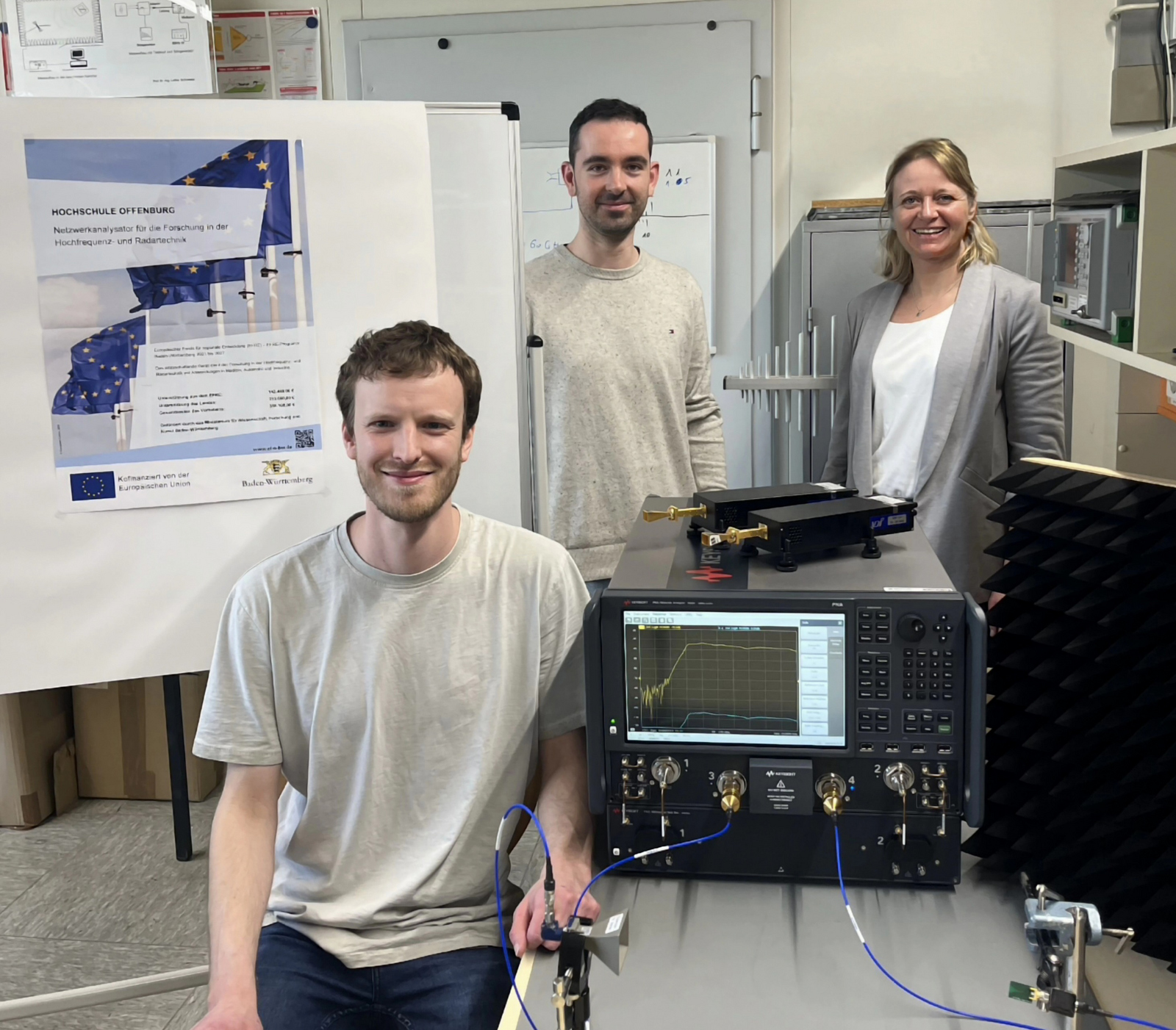
The Institute for Unmanned Aerial Systems (IUAS) at Offenburg University of Applied Sciences now has a vector network analyzer. The device is a key measurement instrument used for the precise measurement and characterization of electronic components such as antennas, amplifiers, and filters. It therefore forms an important foundation for the development of modern high-frequency systems. The Baden-Württemberg Ministry of Science, Research, and the Arts supported the purchase with around €350,000 as part of the European Regional Development Fund (ERDF) funding program "Large-Scale Research Equipment at Universities of Applied Sciences". Forty percent of the project funding came from state funds and 60 percent from the ERDF.
The new vector network analyzer is used in both research and teaching at the Laboratory for High-Frequency Technology and Electromagnetic Compatibility and at the Institute for Unmanned Aerial Systems (IUAS), both headed by Prof. Dr. Marlene Harter. It enables measurements and analyses up to a frequency range of 50 GHz and, with extensions, even frequencies above 90 GHz. The new measurement platform thus supports a significantly broader range of research and development projects than before.
One important research area is millimeter-wave-based skin cancer detection. Researchers are investigating how high-frequency electromagnetic waves can be used for the early detection of skin cancer. With the help of the network analyzer, the developed measurement probes can be characterized and the interactions between electromagnetic waves and biological tissue can be studied.
Another focus lies in the development and investigation of components for automotive radar systems in the frequency range from 76 to 81 GHz. Radar systems are essential for modern driver-assistance functions and autonomous driving. For the analysis of these components and radar systems, the network analyzer is used together with its frequency extension.
In addition, the network analyzer is also used for research in the field of ultra-wideband radar, specifically ground-penetrating radar (GPR). This technology is applied in various research projects at the IUAS—for example, in archaeology for the non-destructive investigation of hidden structures in the ground, or in the construction industry for locating pipes and identifying different soil layers. The expanded analysis capabilities of the new network analyzer are particularly important for the development of the broadband antennas required for these applications.
With this new measurement infrastructure, Offenburg University of Applied Sciences strengthens its activities in applied high-frequency and radar research while also creating modern conditions for research and teaching in a technologically highly relevant field of the future.